From raw keywords and source files to live multilingual sites.
The system builds a reusable evidence library, prepares bounded page packs, keeps a human approval boundary, schedules releases, and renders purpose-built static site architectures. Site-level telemetry and acquisition controls record what happens after publication.
8 public renderer architectures · validated 50,000-page stream · 24 versioned acquisition techniques; 2 automated transports
Estimate your version- Approach
- Adapted to your business
- Hosting
- Your server or cloud account
- Starting range
- $20k–$100k+
- Support
- Handoff or ongoing support
A useful first release, built around the real job
A publishing system fitted to your data, editorial rules, templates, providers, and hosting.
- One working site or vertical
- One primary data source
- One template family
- Generation, review, and publishing workflow
- Deployment and basic operating documentation
- Site-level cost, indexation, and acquisition records
How the system fits together
- Evidence library
- Bounded production packs
- Human review
- Scheduled multilingual release
- Atomic static publish
- Observe and run controlled acquisition
Your version follows your business
The reusable parts give us a head start. Your version still follows your data, staff, approvals, integrations, and infrastructure—not somebody else’s generic process.
This is not a blank-slate proposal
The working system accepts Ahrefs CSVs, source text, images, and video; builds a searchable evidence library; creates bounded production packs; keeps approve, hold, and reject states explicit; schedules multilingual releases; and renders eight public architectures through a Go manifest and Rust static renderer. It also records site-level budgets, technique history, estimates, controlled experiments, delivery attempts, exposures, outcomes, and URL crawl/index observations. Only IndexNow and XML-RPC delivery are automated today; the other 22 techniques remain manual or proposal-only.
When this is the wrong tool
- A first website with no established data, market, or operating owner
- Guaranteed rankings, traffic, citations, leads, or revenue
- Publishing that removes human and legal responsibility from the operator
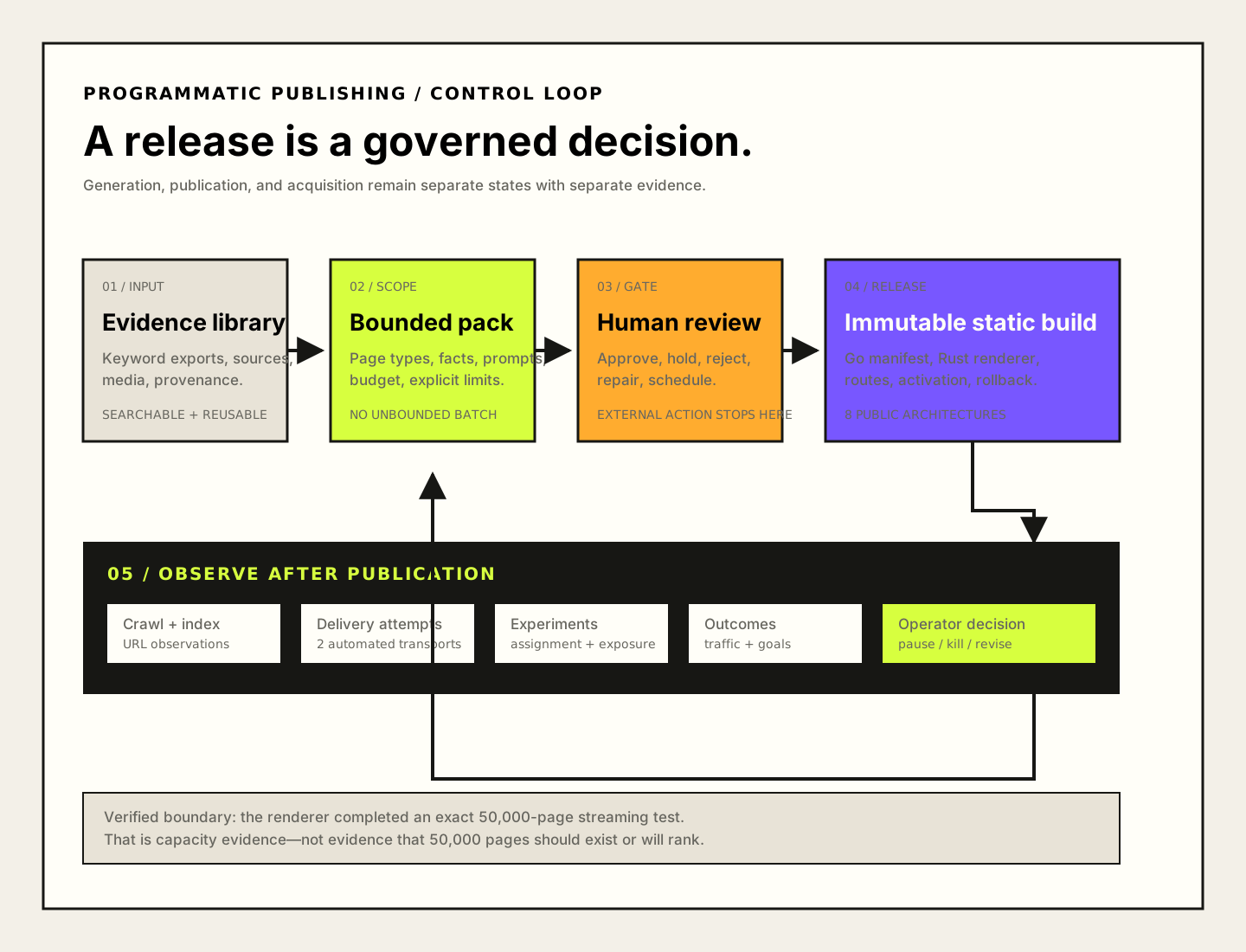
The control loop and three rendered outputs.
The architecture visual explains the operating boundary. The screenshots prove that one governed source library can produce materially different public experiences.


What exists and what it can establish
Measured implementation facts stay separate from business outcomes.
| Subject | Observed or verified | Limit |
|---|---|---|
| Renderer capacity | An exact 50,000-page streaming render completed inside the validation harness. | This proves renderer capacity. It does not prove that 50,000 pages deserve publication or will receive traffic. |
| Public architectures | Eight materially different renderer architectures share the controlled source, review, manifest, and release path. | Architecture breadth is not evidence that every layout fits every query or market. |
| Acquisition controls | Twenty-four versioned techniques can be budgeted, paused, killed, assigned, and observed per site. | Only IndexNow and XML-RPC have automated transports. The other 22 remain manual or proposal-only. |
| Release accountability | Approval states, scheduled multilingual output, immutable builds, and URL-level crawl/index observations remain separate records. | A valid release and an observed crawl do not guarantee rankings, leads, or revenue. |
See where I have used this approach
The case studies show what shipped, what was tested, and what is still unfinished.
Build a first-pass budget
Start with the useful core, then add only the parts your version needs. The calculator updates here in your browser; nothing is submitted until you attach the estimate to an enquiry.
- Core release
- $20k–$35k
- Optional scope
- $0
Selected scope
- Useful core release
Assumptions behind this range
- One person can approve scope and product decisions.
- The source data is usable and available for review.
- Deployment goes into infrastructure you control.
- The reusable core remains mine; your data and business-specific work remain yours.
Messy data, migrations, unusual integrations, compressed deadlines, and deeper production responsibility can move the range.
This is a planning range, not a quote or a promise of delivery dates. I confirm scope, dependencies, and responsibility before proposing a build.
Run it yourself, or keep me around
I fix agreed-scope defects for 30 days after handoff. Then you can take over completely or keep me involved for maintenance, production help, or reserved development time.
Handoff
No ongoing feeYou take over the agreed release. I still fix build defects for 30 days; ongoing updates and operational help are separate.
Maintenance
$1.5k–$3k/monthAnnual commitment. Scheduled releases, security and compatibility fixes, and planned upgrade help. No incident response or custom development.
Production support
$3.5k–$6.5k/monthSix-month minimum. Maintenance, one-business-day response on working days, deployment help, and a monthly allowance for incident or operational work.
Reserved engineering
$7.5k–$12k/monthSix-month minimum. Priority queue, planned release work, and reserved engineering capacity. Unused capacity does not roll over; larger features are scoped separately.
The accepted build includes a defect-correction period. Updates, incidents, and reserved engineering time are paid separately.