Follow the click all the way to the conversion.
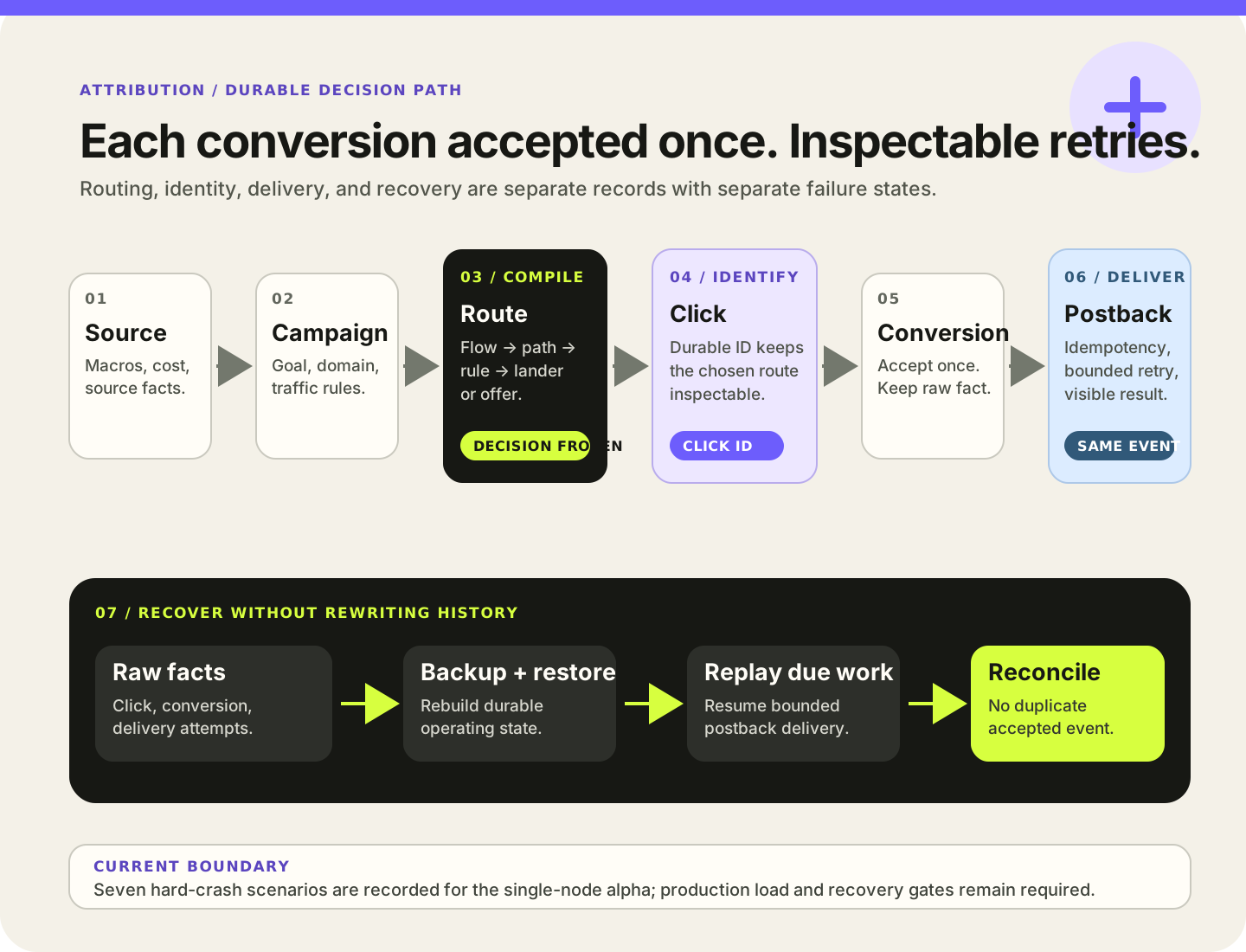
Traffic source → campaign → compiled route → click identity → conversion → idempotent postback → recovery. The system keeps each decision inspectable and deploys on infrastructure the customer controls.
128 MB and 256 MB resource profiles · seven recorded hard-crash recovery scenarios
Estimate your version- Approach
- Adapted to your business
- Hosting
- Your server or cloud account
- Starting range
- $20k–$80k+
- Support
- Handoff or ongoing support
A useful first release, built around the real job
A self-hosted attribution and routing service configured around your traffic sources, campaigns, rules, landers, offers, networks, and reporting needs.
- Traffic-source and campaign configuration
- Flow, path, rule, and route compilation
- Click identity and conversion attribution
- Incoming and outgoing postback handling
- Basic operator and reporting surfaces
- Backup, restore, and deployment runbook
How the system fits together
- Traffic source
- Campaign
- Compiled route
- Click identity
- Conversion
- Idempotent postback
- Recovery and report
Your version follows your business
The reusable parts give us a head start. Your version still follows your data, staff, approvals, integrations, and infrastructure—not somebody else’s generic process.
This is not a blank-slate proposal
The current alpha implements durable Traffic Source → Campaign → Flow → Path → Route attribution, optional landers, offers, incoming conversions, outgoing idempotent callbacks, raw Parquet facts, reporting with explicit limits, backups, restore, and seven recorded hard-crash recovery scenarios.
When this is the wrong tool
- Unlawful traffic, fraud, deceptive redirects, malware, or policy evasion
- Teams unwilling to own their domains, infrastructure, and data responsibilities
- Buyers expecting a finished mass-market SaaS account today
The complete click-to-recovery path.
The diagram marks the durable identity and idempotency boundaries that keep later conversions and retries attached to one inspectable route decision.
What exists and what it can establish
Measured implementation facts stay separate from business outcomes.
| Subject | Observed or verified | Limit |
|---|---|---|
| Compiled route | Traffic Source → Campaign → Flow → Path → Route is compiled before the visit is served. | A configured rule does not prove production throughput or commercial performance. |
| Click identity | The route decision and optional lander/offer path remain attached to a durable click identifier. | The click identifies one recorded interaction, not a person across devices or environments. |
| Conversion and postback | Incoming conversions and outgoing callbacks use idempotency so retries can be inspected without duplicating the accepted event. | Correct delivery does not establish attribution causality or advertiser reconciliation. |
| Recovery | Backups, restore, raw Parquet facts, and seven recorded hard-crash scenarios cover the current single-node alpha. | A production load, restore, and recovery gate is still required before scale or availability claims. |
| Resource profiles | The current alpha has documented 128 MB and 256 MB resource profiles. | Those profiles are implementation evidence, not a universal capacity benchmark. |
See where I have used this approach
The case studies show what shipped, what was tested, and what is still unfinished.
Build a first-pass budget
Start with the useful core, then add only the parts your version needs. The calculator updates here in your browser; nothing is submitted until you attach the estimate to an enquiry.
- Core release
- $20k–$35k
- Optional scope
- $0
Selected scope
- Useful core release
Assumptions behind this range
- One person can approve scope and product decisions.
- The source data is usable and available for review.
- Deployment goes into infrastructure you control.
- The reusable core remains mine; your data and business-specific work remain yours.
Messy data, migrations, unusual integrations, compressed deadlines, and deeper production responsibility can move the range.
This is a planning range, not a quote or a promise of delivery dates. I confirm scope, dependencies, and responsibility before proposing a build.
Run it yourself, or keep me around
I fix agreed-scope defects for 30 days after handoff. Then you can take over completely or keep me involved for maintenance, production help, or reserved development time.
Handoff
No ongoing feeYou take over the agreed release. I still fix build defects for 30 days; ongoing updates and operational help are separate.
Maintenance
$1.5k–$3k/monthAnnual commitment. Scheduled releases, security and compatibility fixes, and planned upgrade help. No incident response or custom development.
Production support
$3.5k–$6.5k/monthSix-month minimum. Maintenance, one-business-day response on working days, deployment help, and a monthly allowance for incident or operational work.
Reserved engineering
$7.5k–$12k/monthSix-month minimum. Priority queue, planned release work, and reserved engineering capacity. Unused capacity does not roll over; larger features are scoped separately.
Production support is capacity-limited. I do not offer a 24/7 response SLA.